The Kingdom is Like…Paella

Jesus, when preaching, often used parables. Too often, we who preach in his name 21 centuries later turn parables into little “moral fables” that teach some sort of truth or are meant to instruct people how to live. As I learned in some great classes back in my ancient seminary days that is unfortunate, that “the church” has attempted to neuter the corrupting, explosive power of the parables. They were used by Jesus, I was taught, open up an experience of the radically new and different reality of existence in the realm  or order of life when God is totally in charge. The parables are metaphors. They should leave us feeling a little off kilter and wondering about what we just heard.

Instead, people in the pews tend to tune parables out and miss the point, since they don’t always have the cultural context and knowledge of those Jesus first told the stories to. “O, I know this one about the ‘Good Samaritan’” they might say. “It’s about taking care of your neighbor. Let’s get on with Mass.” Or is it? Jesus would use everyday situations, events, experiences, stories and objects and trow in a “twist” that wasn’t what the hearers expected. The listener would be left with an experience of being challenged to re-think their preconceived notion of God’s action in human life. As I understand it, the “Good Samaritan” should really be titled “The Man in the Ditch” and is a challenge to us righteous Christian do-gooders to remember in God’s Kingdom God’s mercy is revealed in unexpected people and ways. Don’t box God in, so to speak, to your particular definition of faith and goodness. Open minds are a character trait of the citizens of the kingdom. (It’d take a lot more than a paragraph to make my point about the parable. The next time it’s coming up in the lectionary of the Roman Catholic Church, visit my parish to hear the homily.)

Why all this talk about parables and this blog’s title, “The Kingdom is Like…Paella?” Topic was suggested by an ordinary experience I had last evening that got me to thinking about in the midst of which was the kind of opportunity Jesus would have ceased to further his mission proclaiming the Kingdom of God present in the midst of people who are unaware of it’s presence.

I was invited to a farewell party for a local pastoral associate, Sister J, who is leaving the two parish communities near my parish where she has served for many years. The event brought together the parish pastoral councils of two parishes, all Anglos, and the Hispanic Ministry Council, all Mexicans, which guides outreach to the Spanish-speaking community that gather at one of the parish churches. Sister has been very active in attempting to make the unity of the disciples of Christ in their diversity of language and culture a reality in the parishes. Too often we break down into language groups even when worshiping in the same building. There is value in celebrating liturgy in the language we are comfortable using, yet at times, it is important to visually pray and socialize together to exhibit the unity of our faith even if we can’t totally comprehend the words the other is speaking. So, it was fitting and an attempt to build up the unity of the church that we gathered English and Spanish-speaking, people of German and Mexican heritage for an outdoor picnic to honor and thank the woman who held up this vision for her parishioners as she prepares to take up a new ministry in the church. This is the parish I have begun to celebrate the Eucharist in Spanish at on occasion.

What do you serve at such a gathering. I guess there could have been fried chicken, potato salad, beer and tamales, cactus (which I discovered is supposedly a tasty dish in the Mexican culture) and tequila. But then we’d all have gravitated to that food with which we were familiar. Not much of a sign of coming together over a common table. Then what could be our “eucharistic food,” the food that would symbolize the unity of the Body of Christ?

Why not something that was from another tradition, that both groups would enjoy, perhaps for the first time? How about paella? That was the idea of the lay minister, Bob “Roberto” R. who “pastors” the Hispanic community in our area. A great idea, I thought, as I observed the gathering.

The paella, a dish from Spain, was prepared over an open fire in a huge pan designed for making the dish, about three feet in diameter. The open fire and the novelty of the cooking method drew people around the preparations, asking questions. People were engaging each other in conversation about the unusually large pan, making connections on a very human level (food is essential and something all humans do). Bob, Sister J and others helped make the introductions happen to get people over their initial “shyness” about the folks they didn’t know. Forming community needs the push of a  pastor (at its root a word that means shepherd), sometimes.

cooking the meat for the paella

The Chefs, Roberto and George, begin cooking the pork and chicken for the Paella.

Then there is the dish itself. A huge pan, that needs two people to cooperate to move it, holds all kinds of foods. Shrimp/Camarón, pork/cerdo, chicken/pollo, garlic/ajo, olive oil/aceite de oliva, rice/arroz, peas/guisantes, chicken broth/caldo de pollo, red, green, yellow peppers/pimientas rojas, verdes, amarillas were all cooked in the one pan. Isn’t that the kingdom of God? “It is like a mustard seed that grows into a large bush in which all the birds of the air and various creatures find shelter” Jesus said. Perhaps he could have said of our gathering, “The Kingdom of God is like a Paella feast. All the ingredients in one pan, rich in diversity, like the folks gathered around the one dish, dinning in the Kingdom, feasting, rejoicing in their unity in the Body of Christ. The flavors melding into one while not loosing their distinctness. The people gathered as one, rich in diversity.” Or something like that. Jesus was better at putting together parables. But I hope you get the idea. Probably no one left the gathering “off-balance” from the metaphorical experience (unless too much beer/cerveza was consumed), but hopefully they had a little voice in their head saying, “Wasn’t that a great experience? Maybe that’s what heaven is like.”

Mucho Gusto!

finished paella in pan on the fire

The finished dish of paella before serving. Que bonita!


St. Joseph the Worker

I’m three days late mentioning the Memorial of Saint Joseph the Worker, which occurs in the Roman Catholic liturgical calendar on May 1. But, this morning, checking out on of the blogs I read from time to time, Whispers in the Logia, I noticed that Mr. Rocco Palmo posted a lovely quote from Pope Benedict XVI about the Jesus’ earlier years under the care of St. Joseph, the carpenter. I suggest bopping over to the site and checking out the post “Quote of the Day”  posted on May 1, 2012.

I usually comment at the Mass of the day that I don’t claim this St. Joseph feast as my patronal feast day. (March 19 is the day I claim, Joseph, Spouse of the Blessed Virgin Mary). I have a tenuous relationship with the concept of work. I’d much rather be at rest. Yet, I don’t really consider what I do “work.” It’s a  vocation, not a job. Priesthood is my way of sharing in the saving work of Jesus, carrying on his mission in the particular role of priest. In that sense it is “a work” in which I am privileged to participate.

One of my memories of grade school at St. Dominic Catholic Church in Breese, IL, my home parish, is a religion class in 8th grade where we did collages about “the dignity of work.” This was immediately after the changes in religious education that came about after Vatican Council II and the catechisms of my primary and middle grades had disappeared. It seems like a lot of religion classes involved art projects. I am sure that I really didn’t get the concept of work having a “human dignity” and “religious meaning” at the time. We just cut out pictures of people doing some sort of work and pasted them on roles of newsprint. Then again, maybe I did get something out of the exercise if I still remember it so many years later.

That religion class collage making project was probably my first exposure to the teaching of the church that all human activity can and should be directed toward the building up of the human community into a place of mutual respect and concern. Work is not just for work’s sake, or for the growth of the gross national product index. All human activity is a sharing in the work of creation and building of the Kingdom of God on earth until Jesus brings our work to fulfillment in the second coming. This is what gives work dignity, be it working in a factory or caring for children in the home. All forms of work have the potential of revealing the grandeur, the love and purpose of God for humanity.

The memorial of St. Joseph the Worker established by Pius XII was, on some levels, a response to the May Day celebrations of Marxist countries that supposedly exalted the worker’s place in the social order. There are other civil realm celebrations of the worker on May 1st in other parts of the non-comunist world, too. The day seems to be tied up with the movement to shorten the working hours of employees and worker’s rights. The Church, through this feast, proclaims that humans are not tools of the civil state or economic systems, but sharers in the very “work of God” revealed in the person of Jesus Christ, the redemption and reconciliation of the human community restored to its original state of harmony with God and in the human race. That’s true human dignity.

And, remember, one of the ways we share in the work of salvation is to offer the liturgy of the Church. The Greek word, Liturgia, that is the root of our English word “liturgy” means “work of the people.” Liturgy is work! A sharing in the sacred work of Jesus Christ, whose body we are. The body of the church embodying the Body of the Christ reveals Jesus continuing to offer to the Father the saving work of salvation, his death and resurrection, in every Mass and other celebration of the sacraments. Think how much the Father thinks of us, mere human beings, to permit us to share in the work of the Son!

So while I may not claim the memorial of May 1 as my patronal day, I do celebrate the gift of sharing in the work of salvation both in the everyday life of meetings, pastoral care, administration, feeding the poor, doing the laundry, all those other “mundane chores” and  in the ability to preside at the Church’s liturgy. I hope you do, too.

Blog reading work break’s over. Let’s get to work, brothers and sisters.
Thanks be to God we are judged worthy to share in the work.


El Señor esté con ustedes

Yesterday was a sort of first for me. I presided at my “first” Mass entirely in Spanish. I’ve done parts of the Eucharist and Rite of Baptism in Spanish, before, at my former parish of St. Stephen Catholic Church in Caseyville, IL. But, I had never spoken ALL the prayers, start to finish, in another language than English.

In our area of Clinton County, IL there is a sizable population of immigrants from Mexico. They have been settling here for many years finding work in various agricultural and service industries. Many speak English or are attempting to learn it, but there are always new folks arriving without English skills. Let’s be honest, it’s difficult to pick up a second language as an adult. I would struggle trying to learn something other than English at this point in my life. Their children, of course, learn English much faster. Many are born here. What I think is neat is that these youth are bi-lingual. How lucky they are to be able to communicate in both languages. I studied Spanish in High School, but never really became able to converse in it. Many folks in my parish in Trenton and around the county aren’t aware of how large the population of Spanish speaking neighbors has become in recent years.

We anglos better get used to the idea that Spanish has become a part of life in the United States and in the Catholic Church in our nation. According to an article in U.S. Catholic,

“Between 2000 and 2008 the number of U.S. Hispanics increased from 35 million to 46.9 million, a 34 percent jump. Their numbers will continue to increase at least until 2050, when the Census Bureau projects a count of 102.6 million. At that time, the bishops’ Subcommittee on Hispanic Affairs has estimated, 85 percent of U.S. Catholics will be Hispanic.” (c.f. “Journey to the Center of the Church” Wednesday, June 2, 2010, cited on the web-site of U.S. Catholic, a publication of The Claretians,  http://www.uscatholic.org/church/2010/06/journey-center-church?page=0,1, accessed April 23, 2011. The article originally appeared in the March 2010 issue of U.S. Catholic (Vol. 75, No. 3, pages 27 – 31).

Already, if I remember correctly a statistic I read in the same publication quoted above (but can’t find to site), 50% of the Catholics in this country under 30 years of age speak Spanish at home, already! Some call this the “browning” of the church. I call it a wonderful experience of the diversity of The Body of Christ, “El Cuerpo de Christo.”

I know there is resistance among some in our parishes of southern Illinois to making the liturgy available in Spanish. I ran into that in Caseyville. And I sense that is the case in my present parish. “They’re in this country, they should speak English! Let them come to Mass in English.” But I can’t help wondering if I found myself in anther country for an extended stay or to live where English was not spoken, wouldn’t I long for an opportunity to pray in my “native” tongue where I was comfortable and didn’t have to constantly translate in my mind what was being said. To me, that translating gymnastics would be an obstacle to communicating with the God who brought be to birth and first spoke to me in a particular language through the love of my parents who taught me to speak and in a liturgy of the language of where I was born and raised. Ritual is more than words, yes. The Mass is the Mass in any language and a person can get “something” out of a Mass because the non-verbal symbols still speak the reality of Christ present and worshiped. But, would it be as full of an experience of “the mysteries.” This is one of the reasons the Constitution on Sacred Liturgy of Vatican Council II encouraged the use of the vernacular in the Roman Catholic Church (see article number 36 in the Constitution), to make the liturgy accessible to people.

Sure, eventually, I’d learn the local language and become comfortable in expressing myself in it. I had an aunt, Sister Folgence Rascher, CPpS, who spent over 25 years in Peru. When she would come back to the States for home visits, often she’d have to ask how to say something in English, since Spanish had become so much a part of her everyday and prayer language. In one sense, she became Peruvian, she identified with her adopted people. She was proud of her birth country, occasionally critical of it for the strong influence it had on Peruvian culture, but a woman of faith who knew in her heart that Jesus the Christ was savior of all people and in order for people to know Him, she had to first meet people where they were in their language and culture, not impose a way of communicating learned in a small farming community of north central Missouri where she was born. Sister Folgence was a kind of hero and inspiration to me. I figure a similar journey of enculturation and encounter with Christ is going on for those who come to our country looking for work, the human rights of freedom and dignity.

Those who have settled in this area of Clinton County, traveling from their place of birth in Mexico and points even further south, are my brothers and sisters in faith. If I happened to study Spanish in High School out of admiration for my Aunt Sister Folgence and am able to at least speak it from printed liturgical texts in a way that is comprehensible, then I have a responsibility to offer the sacraments in Spanish to them. I truly believe that God was at work back in those formative high school experiences at Mater Dei High School in Breese (just a few miles from where I live, today) preparing me to be a priest who could offer the sacraments to people in a language that would be a comfortable place to pray while they “sojourned in a foreign land” like the Israelites of old. I suspect Sister Fulgence is smiling down from Heaven at what her nephew is up to.

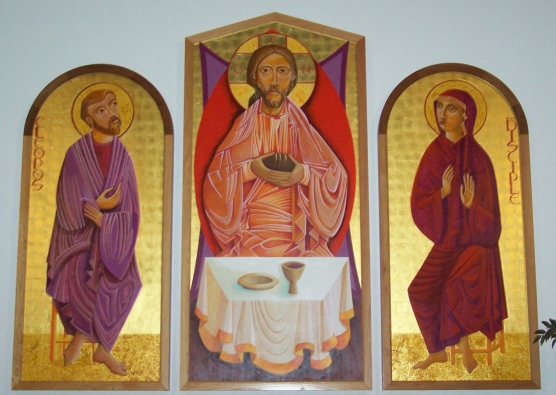
The actual experience of praying the Mass in Spanish was a bit of a challenge. I was pretty nervous. What if I can’t be understood? What if I make a mistake? I’ve been practicing for several months, off and on, once I learned that the priest who usually celebrates the Mass at St. Damian in Damiansville, IL was having serious health problems. He was becoming unavailable to preside. The coordinator of the Office of Hispanic Ministry in the Diocese of Belleville, Sister Cecilia Hellmann, ASC and the local coordinator our deanery hired to minister to the Hispanics in our area, Robert Rapp, were both encouraging me to get busy and practice. Bob reminded me before I processed to the altar, “Just remember. It’s God who’s doing this, not you! Don’t be afraid!” Good advice. He also helped me out by reading the Gospel and giving a “reflection” afterwards about the importance of not being afraid to witness to the faith. I didn’t understand everything in the comments to the folks, but I did catch that and that he used me as an example of trying new experiences to proclaim our belief in Jesus the Risen One. (The Gospel was the story of the appearance of Jesus to disciples after he had appeared to two others on the Road to Emmaus, Third Sunday of Easter, Cycle B. Jesus sends those disciples, who were originally fearful they were seeing a ghost, out to proclaim repentance to the whole world at the end of the pericope.)

I guess things went pretty well. Bob tells me that some of the folks didn’t believe it was my first time celebrating the Eucharist in Spanish! The practicing paid off, it seems. Bob did say I’ve got to work on my “H’s” and “J’s.” H is not pronounced in Spanish, and I have a habit of still pronouncing it. J’s are sounded out like an English H and the old English thinking brain keeps trying to say the english sound. Back to the practice! But the thing he said that I appreciated the most was that he had the sense I was “praying” the prayers instead of just pronouncing what was on the page as some priests have to do who don’t speak the language when leading Mass. He had the sense I knew what I was saying, putting emphasis and interpretation into the prayer. That, I hope, helped the congregation to pray. I know I was focusing more on correct pronunciation than praying, but I guess in time I’ll be praying more than concentrating on correct pronunciation. Heck, I’m still working on “Praying” the new English translation of the Roman Missal with all of its unfamiliar vocabulary and sentence construction! By the way, I can see where the Mexican Sacramentary (which we use for Spanish liturgy in the U.S.) does have places where it is much closer to the Latin original Missal than the previous English Sacramentary, thus exemplifying for me a few of the changes that were made in English. Yet, there’s a lot more “options” and “adaption” of the prayers, too, than we had in English. That’s another whole blog article.

Overall, it was a good experience. I did feel welcomed as the stranger, and thus like the Christ was when he walked that road to Emmaus with two disciples, able to provide for them an experience of his risen presence in the “Breaking of the Bread.” Yet, because the people I prayed with were not familiar to me, maybe I felt a bit like they do when they come to this country, disconnected from the culture and language, hoping to find their place in the community. That’s like anytime I’ve moved into a new parish, though. Faces will become familiar. I might even learn how to converse with the folks a bit. Hopefully, the Kingdom of God was made evident in this world. And, one day we’ll all experience the Lord Jesus gathering “people of every race, language and way of life in the one eternal banquet” of life (from the former translation in English of the Eucharistic Prayer II for Reconciliation).

Sounds like I’m going to do this on a regular basis, doesn’t it? The invitation to preside, again, has been offered. I’ve accepted. A new experience of ministry is taking shape.

Nuestra Señora de Guadalupe, ruega por nosotros.
Sister Folgence, pray for me, assist me to carry on a bit of your ministry.


Easter Homily 2012

Easter Homily, 2012,  St. Mary Parish, Trenton 

Based on Mark 16:1-8
(This is the Gospel assigned to the Easter Vigil for Cycle B. It may also be used Sunday Morning. The Roman Catholic Lectionary uses only verses 1 to 7.  I added verse 8 for the original context.)

This spring we’ve seen the power of devastating forces of nature. tornados ripped through towns in Southern Illinois and destroyed everything, even a church building of our brothers and sisters in Ridgeway. For the people of those towns and parish, life becomes uncertain, their former lives seemed secure, their sense of normalcy is shredded.

Probably all of us have had experiences that radically change our world view. What we thought we knew was true and normal no longer holds, leaving us to acknowledge we don’t know what tomorrow will bring. People lose their jobs in a poor economy. A diagnosis of cancer is spoken by the doctor.

It doesn’t have to be a negative event that shakes up people’s routine lives either. A daughter announces she’s getting married. The pregnancy test comes back positive. Someone wins the Mega Millions lottery in a small southern Illinois town. All life changing events, traumatic and joyful. Such is Easter.

We’re here today because about 2000 years ago there was what you could call a “earth shaking event” that was the destruction of one of way of life and the beginning of an uncharted future. Three women go to a tomb expecting to find a dead body. Instead, they are confronted with evidence that seems to be impossible. The body’s gone. The tomb has been opened and some guy in white is babbling on about their dead friend wanting to see them back home. Well blow me over like a tornado smashing my life to pieces!

You know it’s interesting, very interesting! The three women ran from the tomb in terror. The three early morning visitors to the tomb of Jesus fled from the scene. AND they say nothing to anyone. The news was too shocking, too bazaar. Who would believe them? What’s going on? Perhaps the women were thinking something along the line of these lyrics from an Easter song I like…

Now you leave us trembling and weak,
no more the sureness of death,
no more the world that I knew,
life that is new with each breath.

Where now is the body you wore?
What is this dark empty hole?
Where is the One that I loved?
Where is the fire of my soul?

We, like the three women have all sorts of pain in our lives. We’ve all experienced loss. You and I know the world and even our church is a messed up place. Death, decay; a world that has it’s share of fear is our experience. This is what we’ve all come to expect: that violence, disease, terrorism, heartbreak, poverty and death are the norm of human existence. So if this Jesus is alive, where is the one we loved? Can it be true? Where is this risen Christ? And, finding him what does it mean for the rest of life? Where is the one we love? If what the stranger says is true, that Christ is alive, where is he? Where’s the evidence. An empty tomb proves nothing. Bodies decay. They get moved by cemetery workers.

Where is the one we seek, this Jesus? Here in our midst!!!
Look to the folks who wear the white robe. Some scripture commentators say that the guy in white sitting in the tomb is a symbol of the church, the baptized. Jesus is alive for his work continues in the baptized. Do we not call the church “The Body of Christ?” Do not look for the living in dead history and lifeless cemeteries but in the living folks gathered here today.

In his life, Jesus preached good news and good news is still heard, today, from the church. Words, though not always eloquent, that give hope to people are proclaimed, still.

In his life Jesus forgave sins, and still, all of us experience forgiveness of spouse, of a friend, of God.

Jesus helped those in need and the hungry, the homeless, the sick are tended to, sometimes better than others by church members efforts and institutions, but those in need are still cared for.

Jesus broke bread — we break bread in Mass and know his presence.

If you want to know where this living Jesus is, you must get involved in the church’s life and work, for he is encountered in the life of the church. The risen Christ is encountered in the midst of our relationship with each other as the Body of Christ.

Somehow God’s purpose, that is God’s desire that humans have fuller life that was revealed in Jesus’ actions…Somehow that purpose is still happening in our day, our time, despite the human inclination to be selfish, to cause division in humanity:

in our imperfect works of charity and justice. The work of Christ carries on, for he is risen and lives in the Body of Christ baptized people gathered in the communion of Church. Quite frankly, the church, if it were just a human enterprise would have self-destructed ages ago. It would be a group of nice people trying to do good, but it’s internal problems would have probably caused it to self-destruct. The fact that we’re still here is some sort of evidence that there’s more going on in this group of “nice people” than a human effort at humanitarianism.

God’s power is still pushing back stones of selfishness and sin that entombs people’s lives. Today! Among us who gather. Life is rising out of even the human ability to bring about death. In the resurrection, God pulls the great reversal, showing his power by bringing about a NEW ORDER of existence in raising Jesus Christ. Death leads to life. This is a new day, our life is forever different because of the power of the Resurrection which destroyed the old way of living.

We’ve got a choice:
we can run from the fact of Jesus’ resurrection in fear, say nothing about our faith that life comes from death. After all, our head will tell us, actively living what we believe will just open us up to people’s ridicule.
OR
We can proclaim by our lives what we’ve experienced in our heart and in the life of the Church, that God’s power can bring life out of death. We know He lives because of our experiences of him in the life of the communion of believers. That’s why, even though the first witnesses kept quiet, the news got out. God kept giving people the experience of Christ alive. There are more resurrection stories than three women running in terror from the tomb and saying nothing. And, the Church must follow where Christ leads.

Here in the midst of death, now in the darkest hour, we shall know the face of God,
Here in the midst of life, now in each human form, you shall be the Risen one.

What wondrous love this is that turns death into life!
What a powerful warrior that defeats the enemy death is revealed in Christ!
How amazing is the gift, that we are privileged to share in his victory!

Do not be afraid! Do not be traumatized into silence by this earth shattering event. Seize the opportunity to start life over, again, now and forever.

©2012, Rev. Joseph C. Rascher
May not be duplicated  or distributed in any form without author’s permission. 
Please, link to this web-site to share. 


P.F. Revealers

HOLY THURSDAY HOMILY 2012 -

Given at ST. MARY, TRENTON IL

Scripture:  John 13:1-15

When I was a youngster, there was a brand of athletic shoes that went by the name of “P.F. Flyers.” If you were going to be good athlete back in those days of my youth a kid had to have a pair of P.F. Flyers on his feet. Only today I discovered that the P and F were the abbreviation for Posture Foundation. P F was a patented insoles technology developed in 1933. Perhaps you’ll recall the shoes advertising slogan. Sport styles by PF, which were very popular in the 1950s, were advertised as helping you “run faster and jump higher” courtesy of the “action wedge” that was part of the insoles. P F technology enhanced your game. The P and F of the shoes was what made you better.

Tonight, I’d like to use the abbreviation “P. F. Revealers” to help us enhance our understanding of the mystery we celebrate over the next three days. In this liturgy instead of a pair of shoes there are a pair of  “P.F. Revealers” that deepen our participation in the Paschal Mystery. What we do tonight is not play, but sacramental activity that is our participation in the mystery of our ability to share in the divine life of God revealed in Christ. Every baptized person is a sharer in the life of Christ and there are a pair of “P.F. Revealers,” sacramental signs at work in this liturgy that enhance our understanding of how to share in eternal life.

Let’s say the pair of P.F.s in P.F. Revealers stands for these things:

  • Priest and Feet
  • Poor and Food

The mystery of unbounded, perfect, fuller life is revealed tonight
is a pair of P. F.’s…
Priest and Feet
Poor and Food

This is what I mean…

Jesus is said to have instituted the Priesthood, the Sacrament of Holy Orders, this night at the last meal with friends. Let’s go with that, though some theologians have problems with the thought. The Apostles become the forerunners of what we now call ordained Priesthood. The twelve are given this office of leadership not by being crowned or anointed as priests of the Old Testament but become priests when Jesus tells them to wash feet! “As I have done for you, so must you do for others!”

The authority to lead a community and to preside at what we now call sacraments comes when a man is willing to humble himself like Jesus. Jesus is doing the work of the household slave, not a master of the house. Priests are the sacramental presence of Jesus most when a we put ourselves at the service of a community of believers, when we forgo our ego, when we sacrifice our need to see our wills fulfilled in favor of the needs of the people we are sent to serve. That sacrifice takes form in all sorts of things from baptizing children to burying the dead; teaching the young to administering the life of a parish while forgoing the good of a life long spouse. The best priest is one who in humility says I’m here to serve not to be served, like the servant of old who bowed down to the floor to wash the feet of the important guests. You are the guests, I better not forget it, or I am not the sacramental presence of Jesus in this place.

And so each year on the day we recall the gift of Christ present in the very human person of a priest, the church asks that her priests, from simple parish priest all the way up the hierarchical ladder to Pope, get down on the floor and be an example to their people to remember their position in the Kingdom of God, that of servant. Brothers and sisters, by the willingness of 12 people to bear their feet before us all, tonight, you help me remember who I am, the representative of the servant of humanity, Jesus Christ and whose I am, that I belong to Christ with you. I am so thankful that I am a priest. It has made my life richer, fuller than I could imagine living any other way. In this dying to self, in serving you I am to be an example to you that sacrifice of self does lead to fuller life.

But the washing of feet is not just for my benefit. A priest washing feet is to be a sign to all present that you too are called to wash the feet. “As I have done for you, you must do for others” was not just addressed to the apostles, but to the whole church who the twelve represent in the upper room. (Surely there were some women present who helped with the meal! Those guys didn’t do all the cooking!). Every time one of you changes a diaper, it’s dying to self so the child has a better life. Every time one of you cooks for the family, it’s taking on the role of a slave (and mom sometimes thinks her kids look at her that way!) revealing the one who serves the church the meal of his body and blood. Taking care of the elderly parent, volunteering at the parish, visiting the grieving at the funeral home…all forms of service by a member of the Body of Christ, makes the servant Christ who washes the feet of his disciples present.

Priest and Feet leads us to Poor and Food.

Our experiencing the sacramental sign of Jesus present through “Priest and Feet” leads this assembly to a response of “Poor and Food,” our second “P.F. Revealer.” Who must we serve? Those in need. The poor are members of our family who need us. The poor are people beyond our family in need. We do as Jesus did. We become servants to the poor this night in a symbolic way washing their feet by bringing food to the table. Hopefully, everyone has brought a gift for the poor, tonight, be it food for the Green Bean Pantry or the money from your Rice Bowl. We become a sign of the Love of Christ by serving those in need, sharing our treasure of food and money.

Only when we are willing to sacrifice our time, talent and treasure, only when we are willing to sacrifice ourselves for the sake of others, can the Eucharistic presence of Jesus become a reality on our altar. The earthy food of bread and wine changing into his body and blood must be accompanied by our sacrificing of self that imitates the sacrifice of Jesus on the cross. Food becomes a symbol of the dying and rising of Jesus, because the food is a symbol of the Body of Christ in the pews sacrificing itself like Jesus for the sake of the world. The Eucharist is not magic words transforming food into something else. Our lives of thanksgiving revealed in humble service to others for what Christ has revealed in his passion, which we re-present at the altar, makes the Eucharist possible. In the Gospel of St. John the institution of the Eucharist is not the words “This is my body, This is my Blood, do this in memory of me” but the words that follow the foot washing, “as I have done for you, so must you do for others.” Humble food of bread and wine represent the humble lives of service we lead, baptized into union with Christ’s Body. The servant food, becomes the servant Christ, because the servant church gives thanks under the leadership of its servant priest.

What a marvelous interconnected web of strings of meaning our liturgy weaves for us, tonight! Our pair of “P.F. Revealers” helps us delve more deeply into the mystery of life coming from death, richer living revealed in self-sacrificial service of others.
Priest and Feet
Poor and Food
show us the way to life in Christ, now and beyond death, forever,

Priest and Feet
Poor and Food
be the revelation of the “must have” truth that will make our life complete.

©2012 Rev. Joseph C. Rascher
May not be copied without permission  and  attribution of authorship


Palm Sunday 2012 Homily

Servers lead the procession of palms on Passion Sunday 2007 at St. Stephen Catholic Church, Caseyville, IL, my former parish.

Scripture for the day:
Isaiah 50:4-7
Psalm 22:8-9, 17-18, 19-20, 23-24
Philippians 2:6-11
Mark 14:1-15:47

Homily given at St. Mary Catholic Church, Trenton IL, April 1, 2012

By Rev. Joseph C. Rascher, Pastor

Have you ever had an experience of thinking, “I should just cut my losses and get out, now, before things get worse?” Maybe you have been investing for retirement. A couple of years ago, especially when the market went bad and the value of your IRA was shrinking daily, perhaps you thought, “I should cut my losses and get out, now!” Or maybe you’ve been in a relationship with someone, a friend, who is becoming more and more demanding of your attention than you have time to give. The though enters the mind, “I should get end this friendship. It’s not worth it!”

In the Passion of Jesus according to the Gospel of Mark we just heard proclaimed everyone but one person Cuts their loses…
Judas Iscariot is thinking that this Jesus is getting too hard to take. Jesus insists on letting sinners off the hook and isn’t concerned about restoring Israel to glory like I thought he would.
Peter, the best friend wants to be there for Jesus, but in the end self-preservation kicks in and he thinks he’s better off saving my own skin. He cuts his losses so fast, in the instant of time it takes a cock to crow, Peter doesn’t admit he knows Jesus.
Chief priests cut their losses, scared of upsetting the balance, or more so waking the sleeping giant of the civil government of Rome. Rather than risk a crack down on their power in society and the ability of people to worship and maintain the status quo they push for the death of an innocent man on trumped-up charges.
Then there’s Pilate who is afraid of civil unrest and a situation that could cost him power in the Roman Government he’s schemed so hard to get condemns to death a man he’s not convinced needs to die.

It even sounds like Jesus wonders if God, his Father, has given up the cause Jesus has invested his life proclaiming. We hear Jesus saying, “My God, My God – why have you forsaken me?”

Actually, this is Jesus’ statement of faith. Jesus is quoting Psalm 22 (our responsorial psalm this morning). It’s like he’s saying to anyone who will listen

“You want to know what I believe? You want to understand why I’m willing to go through this torture and die? Check out the Psalm that begins  “My God, My God…” and remember all the stanzas, read it to the end. Jesus is giving us a title of a song that helps him and us understand what he believes.

What is the end of the Psalm that Christ wants people to recall?

I will proclaim your name to my brethren;
          in the midst of the assembly I will praise you:
You who fear the LORD, praise him;
          all you descendants of Jacob, give glory to him;
revere him, all you descendants of Israel!

Jesus is saying, “I will not cut and run! I will not give up on God my Father! He’ll make something good come out of this! I refuse to give up because I know I’ll be praising him, again!

We are here, today, because Jesus didn’t cut his loses and take the safe way out. His death, and our ability to share in the effects of his death by our baptism and Eucharist is why we can face the difficult situations of human existence and not give up hope! In the story of the passion we proclaim that sacrificial love triumphs over every thing that is evil, even death. Everything that seeks to diminish human life is powerless in the light of the resurrection of Jesus that was only possible because the Christ didn’t cut his losses and take the safe way out.

We live in a world where looking out for yourself and protecting what you got is the norm. If we say we claim to follow Jesus, (and that is what we did by taking part in the procession with blessed palms this morning) then we better be ready to risk everything, including our life, when the time comes, and bet it all on the hope that God is faithful.

Those who refuse to take a chance on the truth of the Name above all other names and worry about saving their own skin we’ll be nothing more than a bit players in the drama of eternity, like Judas, the chief priests and Pilate.

Those who cut and run to a false safety perhaps are like the character the Gospel mentions, a young man covered only in a linen cloth who runs off naked. Think about it. Christ is wrapped in a linen cloth after death and placed in the tomb to await the resurrection. Baptized people are clothed in white (linen) garments after burial with Christ in the tomb of the font. The “naked runner” might be a symbol of baptized folks who cut their losses and run, abandoning faith and trust in the Father by leaving the church or sinning greatly. Without faith, without membership in the church, cutting your losses and running, people are left as defenseless as a naked man, exposed to danger, the potential victim of all sorts of forces that can injure a human.

Because we’re members of the church, forgiven of our sinful lapses in courage to witness to the Gospel like Peter is on Easter morning on the beach sharing a breakfast of fish with the risen Christ. Peter is the symbol of the church in the Gospel narratives. At least we have the hope of being redeemed and restored to eternal friendship with Christ if we remain in union with the church. We will be restored to life by the power of Jesus’ sacrificial death we participate in by our willingness to allow his mercy to be part of our life as we follow the Way of the Cross until the day we die in union with the Church, his body on earth.

With Mary Magdalene and Mary the mother of Joses and Salome, we wait on this side of the grave, bravely facing what ever happens to us, to see the day our trust in God is vindicated. We refuse to run away from tragedy and trust the truth of Jesus is our truth. God will not disappoint. We hope, we trust, we believe the stone will be rolled back from our graves, too.

© 2012, Rev. Joseph C. Rascher

Children waving palm branches in the Palm Sunday procession at St. Stephen, Caseyville IL,  2007

Hosanna! Hosanna! Let us follow Jesus to his death, as trusting as children who know their parents will protect them and give them what they need to live.


Etch-A-Sketch and Lent

Here’s one for the I wish I would have thought of that file…

I recommend this blog entry for your reading. The author, the Rev. Christopher Keating, a Presbyterian pastor,  pulls together some recent political news  and the Season of Lent (God forbid you change your position in Politics verses the expectation to admit you were wrong and change your ways in your spiritual life!).

Check out Starting over with an Etch a Sketch at the Civil Religion Blog site of the St. Louis Post Dispatch website.

I’ve been taking a slightly different approach to preaching the series of readings assigned to the current cycle of readings, which is the same as the Rev. Keating refers to, preaching about the history of the convenential relationship of God and humanity that reaches its perfection in Jesus. But, I like his idea of God giving us the chance to start over again and again, too. Such is the beauty of the Scriptures – so many ways to get to explore how to preach the eternal truth of God’s love for humanity, his unwillingness to give up on us.


Making Devotions Fun Since 1981

One of my passions as a priest (who was ordained in 1981 – thus the title of this article) has to been to help people more deeply understand the various liturgical rites of the church. I often try to find new ways to help people to encounter the power of liturgy that shapes and forms us as Christians. This is always done with an eye to the rubrics in the official liturgies (like the Mass) yet to celebrate the rites with full, robust and reverent use of symbol (lots of water at baptism, generous amounts of oil in anointing…). It comes naturally, it seems, for me to think outside of the box when adapting our Catholic rites and devotions. Some ways of doing rites don’t have to be done the same way over and over again just because “that’s how it’s done” or “it’s always been done this way.” My challenge to myself has been study the rite, explore how it’s ritual action can be done in a way that makes the meaning more clear and faithful to the meaning of what is taking place. Ask a few brides how I’ve challenged their concept of what a wedding should look like!

My desire to adapt and think “differently” about the enactment of rituals finds expression especially when it comes to devotional practices like Stations of the Cross and the Rosary.There is a richness to the Catholic ritual and prayer life that I sometimes wonder if people “get.” In particular, I want children to know the beauty of our liturgical and devotional life. I used to have move opportunity to teach and celebrate liturgy with children when I was at my previous parish since it was co-sponsor of a Catholic Grade School. Here, in my present parish, the interaction with children is a bit curtailed since there is limited time in the Parish School of Religion classes and I don’t want to take away too much time from their class time. Yet, the desire to make the ritual and devotional life of Catholics more interiorized and a part of their formation as disciples of Jesus leads me to look for opportunities to creatively have the children experience Catholic prayer that they might not otherwise be exposed to.

Such was the experience of yesterday, the 5th Sunday of Lent, of getting creative with an age-old pious traditional prayer of the church so that the youth (and their parents) would learn something about the history of the prayer, experience the prayer and maybe be moved in the heart by the prayer of The Stations of the Cross. The volunteer catechists were a bit anxious about the activity, I hear from the parish Coordinator of Religious Education, but with her and their help which I greatly appreciate, the morning’s event was a positive experience for all.

Several weeks ago I suggested to our parish Coordinator of Religious Education that since the stations of the Cross were originally a pious practice that pilgrims to Jerusalem actually walked the “via crucis” of Jesus through the streets of Jerusalem to Calvary and then to the place of his burial, we should have the students experience walking from station to station outdoors. For centuries, thanks to the Franciscans who initiated the practice of setting up stations of the cross at churches in other places other than Jerusalem for people to “make the pilgrimage” to Calvary, generations of Catholics have symbolically been able to retrace the steps of Jesus. But, what has happened, in most places is that when the stations are prayed people stay put in their pew while a cross and two candle bearers walk the stations in the place of the assembly. This is how I experienced the Stations as a child. Whenever we hold stations in my parish I encourage people to walk along with me and the assisting ministers around the church.

I wanted the children to know the roots of the devotion and to see the norm is walking during the stations. Also, I wanted them to be more involved in making the stations their own than just saying someone else’s words while looking at someone else’s artwork. Since we don’t have a set of outdoor stations of the cross like some churches and retreat houses I decided the youth could make their own stations of the cross. I envisioned simple crosses drawn on the pavement of our parking lot with chalk. With the help of our CRE and catechists, the idea grew and so did the artwork. The catechists were given a card the CRE had found with pictures of the 14 traditional stations (I originally had planned to use the newer 14 designated by John Paul II which this parish is not familiar with, apparently). The youths were divided into groups, mostly by grade, and assigned a station to draw on the pavement that spans a city block. 30 minutes later the “stations” were ready and a short catechesis was given by me. The children were taught the traditional call and response “We adore you O Christ, and we praise you.” “By your holy cross you have redeemed the world” and how to genuflect during its recitation. We learned a simply sung refrain to sing while moving from station to station “Jesus, remember me when you come into your Kingdom.” At each station, a student read the name of the station and a sentence about it which I followed up with a short spontaneous prayer. Nothing elaborate was the intent. Just be simple and show that they could do the same thing on their own (in church or at home). With a word to be prayerful (the group was!) and no talking between stations, we were off to the first station and a journey into discovering the power of devotion, re-imagined, yet traditional and centuries old. It was a good experience for the parents, the youth, the catechists and the priest. I hope the children remember it as another way to encounter the mystery of Christ’s love. Perhaps we’ve begun a new annual tradition here at St. Mary, too.

Chalk Drawing of First Station of the Cross, Jesus is Condemned to Death

The First Station, Jesus is Condemned to Death

Chalk drawing of third station, Jesus falls the first time

The Third Station, Jesus Falls the First Time

Children's chalk drawing of the Fourth Station, Jesus Meets his Mother

The Fourth Station, Jesus Meets his Mother

Fourth Grade PSR Class with their drawing of the Third Station

Fourth Grade PSR Class proudly exhibits their depiction of the third station, Jesus falls the first time. (Photo by Mark Moss)

Kindergarten PSR class drawing their depiction of the 4th Station

Kindergarten PSR class drawing their depiction of the 4th Station (Photo by Mark Moss)

Confirmation Candidates draw the Twelfth Station

Confirmation Candidates draw the 12th Station, Jesus Dies on the Cross

Since the stations will stay on the pavement a couple of days until it rains or they’re worn off by cars and children from the middle school playing on the pavement I did tell the youth who attend school in our building that’s rented to the public school district that it was their duty to “evangelize” their classmates who were not Catholic. Surely, their friends and teachers would want to know what the pictures were. Even children, as members of the baptized, are to proclaim the Good News and this was going to give them an opportunity to live out their baptismal vocation in a unique way. Who knows what seed will be planted to bear fruit in the future because we decided to re-imagine a traditional devotion on the parking lot.

PSR Students, Adults and Pastor genuflecting around a chalk draw "Station of the Cross" on the parking lot at St. Mary

We adore you O Christ, and we praise you,
Because by your holy cross, You have redeemed the world!


Feast of St. Joseph

Sometimes, I’m not always quite “with it” when I wake up in the morning or even know the date. And, if I don’t happen to celebrate Mass in the morning, I might not realize what day it is in the Church year till later in the day. Today, March 19, it was a few hours before I looked at a calendar and remembered that it was the feast day of my patron saint, St. Joseph! In my spiritual life, it’s a biggie day. Oppps!

After finishing my last post, I decided I’d like to post a picture or reflection on St. Joseph. Rather quickly I stumbled onto this picture of St. Joseph that I found to be a bit different from the usual more “pious, saccharine” images of traditional Catholic “art” and holy cards. I was attracted to it, probably, because it shows a younger (Middle-aged like myself”) Joseph and Jesus as a young teenager. It is not often that artists portray that age of the subjects. I was drawn, too, to the intimacy, the affectionate way that Jesus is holding the hand of his foster-father.

picture of St. Joseph as middle aged man with hands on shoulders of Jesus portrayed as a teen

St. Joseph and Jesus

The picture is taken from an Archdiocese of Washington web-site and blog. The particular blog entry is authored by a Monsignor Charles Pope who wrote the entry St Joseph: Model Husband and Father – A Reflection for the Feast of the Holy Family. I’ve done a quick read of the article and find it a very nice meditation on St. Joseph as a model for Catholic men, especially those called to the vocation of marriage (leaves me out, but some of the points still can be applied). There’s a short video embedded at the end of the blog entry that is worth watching, too.

Grant, we pray, almighty God,
that by Saint Joseph’s intercession
your Church may constantly watch over
the unfolding of the mysteries of human salvation,
whose beginnings you entrusted to  his faithful care.
Through our Lord Jesus Christ, your Son,
who lives and reigns with you in the unity of the Holy Spirit,
one God, for ever and ever.

Taken from the Roman Missal, Third edition English Translation
Collect for the Feast of St. Joseph, Spouse of the Blessed Virgin Mary, March 19


Brother Love’s Traveling Reconciliation Show

With apologies to Neil Diamond (Yes, I’m old enough to remember his early performances in the 1960’s) who made a hit out of the song “Brother Love’s Traveling Salvation Show” one of my brother priests who was part of a group of us hearing confessions yesterday reminded me of this title. My parish is part of a group of four parishes that hold communal reconciliation liturgies in each one of our churches on Sunday afternoons during Lent. Two on one Sunday and two on the next Sunday, which requires a bit of quick travel between the two parishes to make it to the next church on time. My brother priest referred to it as the “Traveling Reconciliation Show” between yesterday’s two locations.

It is Lent, and many Catholics feel the need to celebrate the Sacrament of Reconciliation. Many of them don’t for various reasons. I’m not here to judge, but I do find it a powerful encounter with Christ both as penitent and the minister of the sacrament. Sometime I’ll have to write more about my experiences. For now, I offer two poems by a favorite author, Scott Cairns, for your Lenten reflection that might help you prepare for the Sacrament of Reconciliation. Take your time with them and ponder what they are revealing. The Sacrament of Reconciliation can stir in the heart the same thoughts and have the same effect as what is written of in the poems.

The Spiteful Jesus

Not the one whose courtesy
and kiss unsought are nonetheless
bestowed. Instead, the largely
more familiar blasphemy
borne to us in the little boat
that first cracked rock at Plymouth
petty, plainly man-inflected
—demi-god established as a club
with which our paling
generations might be beaten
to a bland consistency.

He is angry. He is just. And while
he may have died for us,
it was not gladly. The way
his prophets talk, you’d think
the whole affair had left him
queerly out of sorts, unspeakably
indignant, more than a little
needy, and quick to dish out
just deserts. I saw him when,
as a boy in church, I first
met souls in hell. I made him
for a corrupt, corrupting fiction when
my own father (mortal that he was)
forgave me everything, unasked.

from:
philokalia: new and selected poems
 by  Scott Cairns

Page 11 © 2002
Zoo Press, PO Box 22990, Lincoln NE 68542

Adventures in New Testament Greek:
Metanoia

Repentance, to be sure,
but of a species far
less likely to oblige
sheepish repetition.

Repentance, you’ll observe,
glibly bears the bent
of thought revisited,
and mind’s familiar stamp

—a quaint, half-hearted
doubleness that couples”
all compunction with a p ledge
of recurrent screw-up.

The heart’s metanoia,
on the other hand, turns
without regret, turns not
so much away, as toward,

as if the slow pilgrim
has been surprised to find
that sin is not so bad
as it is a waste of time.

from:
philokalia: new and selected poems
 by  Scott Cairns

Page 11 © 2002
Zoo Press, PO Box 22990, Lincoln NE 68542


Follow

Get every new post delivered to your Inbox.